Past Exhibitions
Oblique Views: Archaeology, Photography, and Time
October 25, 2015 through May 7, 2017
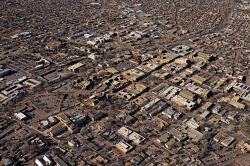
Santa Fe
While still not large, Santa Fe has grown remarkably since 1929. Houses cover the areas that were once farmed, and flat roofs around the Plaza dominate the scene. The Palace of the Governors (now backed by the New Mexico History Museum), the New Mexico Museum of Art, the cathedral, and other beloved buildings are still in use. The Roundhouse has replaced the old capitol building, which was remodeled and converted to administrative use. The river still flows through Santa Fe, at least seasonally, but it is less visible among the sea of buildings that engulf it. A few solar panels show environmental investment by individuals. Photograph by Adriel Heisey, 2015.
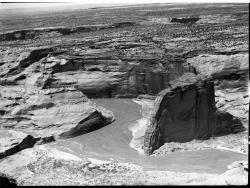
White House Ruin
White House Ruin is composed of two parts: a larger room block on the canyon floor that rose to four stories high in the back, and another set of rooms built in a rock shelter immediately above. The upper rooms could have been reached from the fourth-story roof of the lower structure. The bulging, stained walls of the rock face above the rock shelter have made the site a favorite photographic subject. Timothy O’Sullivan photographed the site in the mid-1870s, and it has been well photographed ever since, including by Ansel Adams. Photograph by Charles A. and Anne Morrow Lindbergh, 1929.
For the first time in Oblique Views: Archaeology, Photography, and Time, large prints of Heisey’s stunning images will be paired directly with the Lindberghs’. The exhibition opens October 25, 2015 and runs through May 7, 2017 at the Museum of Indian Arts and Culture.
During 2007 and 2008, flying at alarmingly low altitudes and slow speeds, Adriel Heisey leaned out the door of his light plane, and holding his camera with both hands, re-photographed some of the Southwest’s most significant archaeological sites that Charles Lindbergh and his new bride Anne photographed in 1929.
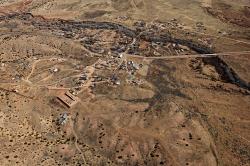
Galisteo
Galisteo is now considered statistically part of the Santa Fe metropolitan area, although it is still remote and has a population of less than three hundred people. It is home to a number of well-known artists and scholars, as well as families traditionally linked to the area, none of whom farm on the scale of the past. Galisteo Creek no longer washes away vegetation in the streambed, which now appears to be a lush forested strip. The church and cemeteries remain, as does the layout of the colonial village. Traces of the old narrow fields can still be seen. Photograph by Adriel Heisey, 2015.