Current Exhibitions
Turquoise, Water, Sky: The Stone and Its Meaning
April 13, 2014 through May 30, 2016
Turquoise, Water, Sky: The Stone and Its Meaning highlights the Museum’s extensive collection of Southwestern turquoise jewelry and presents all aspects of the stone, from geology, mining and history, to questions of authenticity and value.
People in the Southwest have used turquoise for jewelry and ceremonial purposes and traded valuable stones both within and outside the region for over a thousand years. Turquoise, Water, Sky presents hundreds of necklaces, bracelets, belts, rings, earrings, silver boxes and other objects illustrating how the stone was used and its deep significance to the people of the region. This comprehensive consideration of the stone runs through May 2, 2016.
View the online version of the exhibition at http://turquoise.indianartsandculture.org
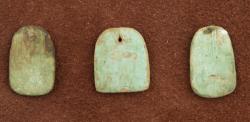
'Fake' Turquoise
To the Native American it is the turquoise color that carries all the power and references to sky, water, birth, health. The stone does not necessarily have to be used for ritual or decoration. These pieces dating from 800-1200AD are wood painted to resemble turquoise. Given the scarcity of turquoise and the difficulty mining the fragile stone with primitive tools these three pieces are not fake in the eyes of a Native American.
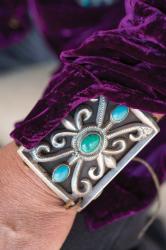
Ketoh (Bow Guard)
Ketohs, or bow guards, were traditionally worn to protect an archer’s arm from the sting of a released bowstring; today, they are worn as decoration. This ketoh (circa 1912) pairs two glass cabochons with one of real turquoise. So-called Hubbell glass was imported into the region during a period when turquoise was difficult to acquire. Artists used it because it had the right color, but tourists rejected it as “fake.” (Courtesy of the Museum of Indian Arts and Culture/Laboratory of Anthropology. Photograph by Kitty Leaken.)
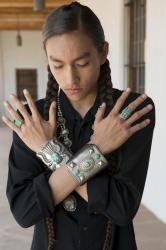
Young Man with Bow Guards (Ketoh)
The Navajo (Diné) and Hopi developed an arm guard to provide protection while shooting an arrow from a bow called a ketoh. It is often sports a central motif, decorated with silver and turquoise. While functional they are normally personal and ritual adornment.
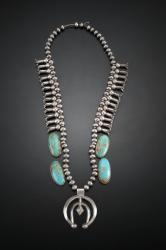
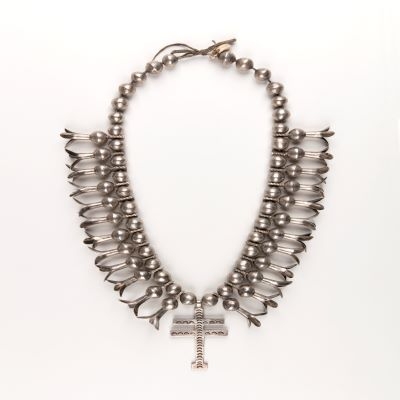
Squash-blossom necklace
Squash-blossom necklace, 1920–39, Navajo, maker unknown. Silver, Turquoise Mountain turquoise. Museum of Indian Arts and Culture/Laboratory of Anthropology (45626/12). Photograph by Blair Clark.